
Casino Licences
 Available in GB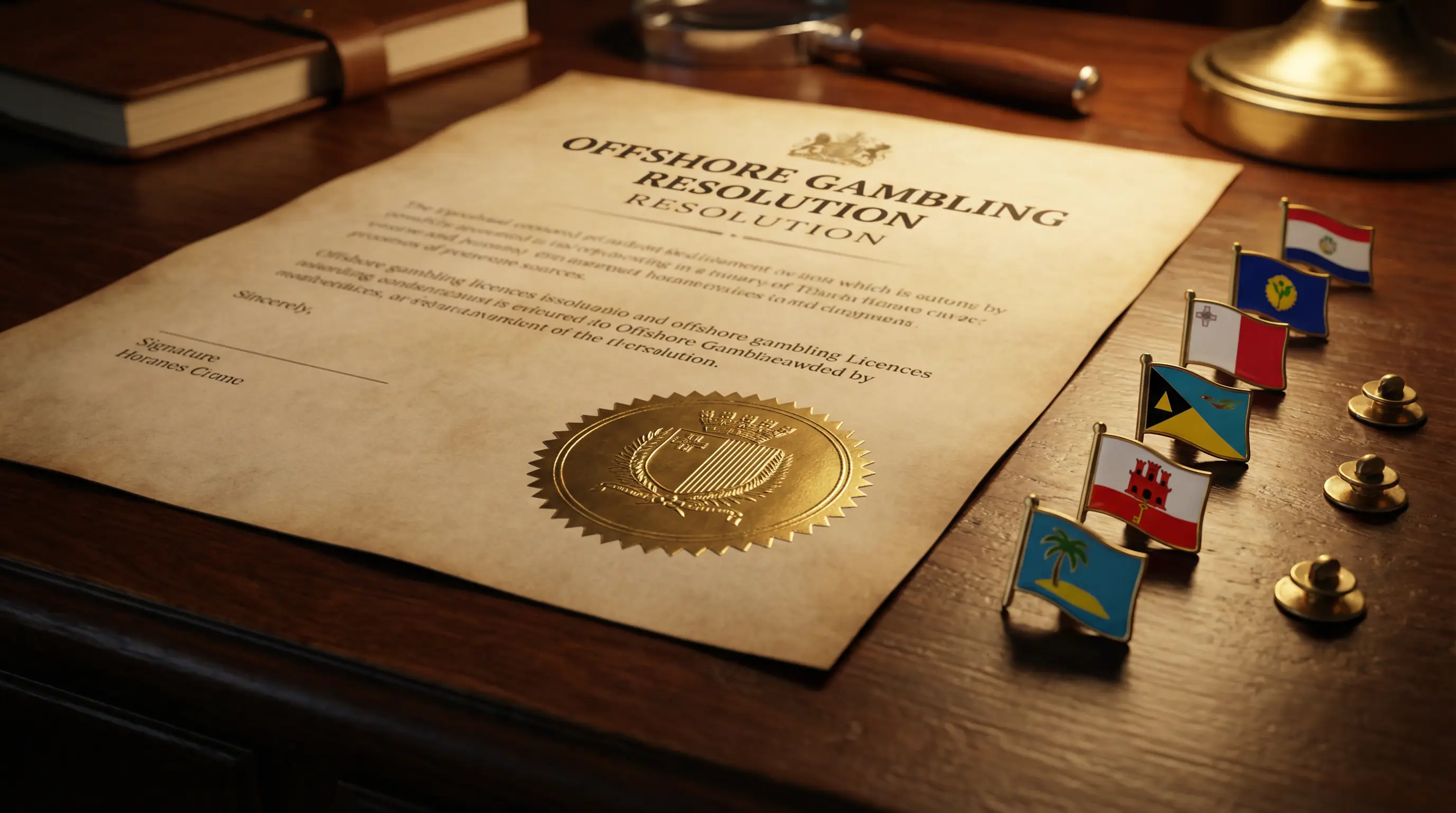
Offshore Licences — The Patchwork System Behind Non GamStop Casinos
Not all licences are created equal — some regulate, others just rubber-stamp. When a non GamStop casino displays a licence badge in its footer, that badge tells you where the casino is registered and which regulatory authority oversees its operations. What it does not tell you, at least not without further investigation, is how much oversight that regulator actually provides. The gap between the strictest offshore licence and the most permissive one is enormous, and UK players navigating the non GamStop market need to understand where those gaps lie. Find licensed casinos at newnongstopcasinos.
The concept of offshore licensing in online gambling is straightforward. A jurisdiction creates a legal framework for issuing gambling licences, establishes a regulatory body to administer them, and charges operators a fee for the privilege. In return, the operator gains legitimacy — a licence number, a regulatory seal, and the ability to present itself as a regulated business. The quality of what happens after the licence is issued — ongoing compliance checks, player complaint resolution, financial audits, enforcement actions — varies dramatically from one jurisdiction to the next.
Four jurisdictions dominate the licensing landscape for non GamStop casinos serving UK players: Curaçao, Malta (through the Malta Gaming Authority), Anjouan (a semi-autonomous island in the Comoros archipelago), and Gibraltar. Each operates under different legislation, different fee structures, and fundamentally different philosophies about how much intervention a gambling regulator should exercise. A Curaçao licence and a Malta Gaming Authority licence are not interchangeable signals of quality, and treating them as such is one of the most common mistakes UK players make when evaluating offshore casinos.
The licensing jurisdiction matters because it determines the rules the casino operates under, the protections available to players if something goes wrong, and the likelihood that the regulator will intervene if the operator misbehaves. For a UK player accustomed to the UKGC’s comprehensive regulatory framework, understanding these differences is not academic — it is practical information that directly affects the safety of their deposits and the reliability of their payouts.
Curaçao, MGA, Anjouan, Gibraltar — Four Licences Compared
The jurisdiction on the licence determines the rules the casino plays by. Here is how the four most common offshore licensing authorities stack up against each other — and what each one means in practice for a UK player.
Curaçao eGaming is by far the most common licence among non GamStop casinos. The island, a constituent country of the Kingdom of the Netherlands, has been issuing online gambling licences since 1996 through a system of master licences. Historically, Curaçao’s licensing regime was notable for its low cost of entry, minimal ongoing compliance requirements, and limited player protection infrastructure. A single master licence could be sub-licensed to dozens or even hundreds of operators, creating a situation where the regulatory body had limited direct oversight of individual sites.
In late 2023, Curaçao began implementing reforms, with the Curaçao Gaming Authority (CGA) initiating a phased overhaul of the online gaming regime. The comprehensive National Ordinance on Games of Chance (LOK) was approved by Parliament on 17 December 2024 and entered into force on 24 December 2024. The reforms introduced stricter KYC requirements, mandatory responsible gambling tools, and direct licensing (replacing the sub-licence model). These changes are still being phased in through 2026, and their real-world impact on operator behaviour is not yet fully apparent. For UK players, a Curaçao licence is now a somewhat more meaningful credential than it was five years ago, but it still represents the lower end of regulatory rigour among the four jurisdictions discussed here.
The Malta Gaming Authority sits at the opposite end of the spectrum. The MGA is one of the most respected gambling regulators outside the UK, with a comprehensive framework that includes mandatory player fund segregation, detailed reporting requirements, approved third-party auditing, and a formal player complaint process. MGA-licensed operators must comply with anti-money laundering regulations aligned with EU standards, and the authority has a track record of revoking licences from non-compliant operators. For a UK player, an MGA licence is the strongest offshore signal of legitimacy. The catch is that most MGA-licensed casinos also hold UKGC licences and are therefore on GamStop. Non GamStop casinos with MGA licences exist but are comparatively rare.
The Anjouan Gaming Authority is a newer entrant to the offshore licensing market. Anjouan, a semi-autonomous island in the Union of the Comoros, began issuing online gambling licences through the Anjouan Corporate Services authority. The licensing framework is less established than either Curaçao or Malta, with limited public information about complaint resolution processes and enforcement actions. The low barrier to entry has made Anjouan licences popular among newly launched non GamStop casinos, particularly those focused on the UK and European markets. From a player protection standpoint, an Anjouan licence offers fewer verified safeguards than either an MGA or reformed Curaçao licence.
The Gibraltar Gambling Commissioner regulates online gambling from a jurisdiction with strong ties to the UK. Gibraltar’s regulatory framework is comparatively robust, with requirements for financial audits, technical systems testing, and responsible gambling provisions. Historically, many UK-facing gambling companies have been headquartered in Gibraltar for its combination of credible regulation and favourable tax treatment. However, most Gibraltar-licensed operators also maintain UKGC licences for their UK-facing operations, which means they participate in GamStop. Finding a non GamStop casino with a Gibraltar licence alone is unusual — when it exists, it typically reflects an operator that serves multiple markets but has chosen not to pursue UKGC authorisation for its UK-facing brand.
| Jurisdiction | Regulatory rigour | Player fund protection | Complaint resolution | Prevalence at non GamStop sites |
|---|---|---|---|---|
| Curaçao | Low–moderate (reforms underway) | Not consistently required | Limited formal process | Very high |
| Malta (MGA) | High | Mandatory segregation | Formal ADR process | Low |
| Anjouan | Low | Not verified | Minimal public process | Growing |
| Gibraltar | Moderate–high | Required | Available through Commissioner | Very low |
How to Check Whether a Casino’s Licence Is Real
A logo in the footer is decoration — a number in the regulator’s register is proof. Verifying a non GamStop casino’s licence is the single most important step a player can take before depositing money, and it is far simpler than most people assume. The entire process takes less than five minutes and requires nothing more than a web browser.
Start at the bottom of the casino’s homepage. Legitimate operators display their licence information in the footer, typically including the licence number, the name of the issuing authority, and sometimes the legal entity that holds the licence. If the footer contains a generic seal image with no licence number, that is the first red flag. A real licence has a unique identifier — a number or code that can be cross-referenced against the regulator’s public records.
Next, go directly to the regulator’s website. For Curaçao, the Curaçao Gaming Authority (CGA) maintains a register of licensed operators at its official domain. For Malta, the MGA publishes a searchable licence register on its website at mga.org.mt. For Gibraltar, the Gibraltar Gambling Commissioner’s site provides a list of licensed operators. Search for the licence number or the company name. If the casino claims a Curaçao licence but the licence number does not appear in the CGA’s register, the licence is either expired, fake, or assigned to a different entity.
Pay attention to the legal entity. A non GamStop casino might operate under a consumer-facing brand name that differs from the registered company name on the licence. This is normal — many gambling companies operate multiple brands under a single licence. What matters is that the company name listed in the casino’s terms and conditions matches the company name in the regulator’s register. If the casino’s terms reference “ABC Ltd” but the regulator’s register shows the licence belonging to “XYZ Ltd,” that discrepancy needs an explanation.
Check the licence status. Regulators typically indicate whether a licence is active, suspended, or revoked. An active licence means the operator is currently authorised to offer gambling services. A suspended or revoked licence means the regulator has intervened — and a casino displaying a revoked licence as though it were active is engaging in outright deception.
Finally, verify the date. Licences have expiry dates. An operator displaying a licence that expired six months ago is operating without valid authorisation, regardless of what the footer badge suggests. This check takes seconds and eliminates one of the most common forms of misrepresentation in the offshore casino market.
The Licence Is the Starting Point — Not the Finish Line
A Curaçao licence says a casino met the entry criteria — it doesn’t say it kept meeting them. This distinction is critical for UK players who have been conditioned by the UKGC’s proactive enforcement model, where the regulator conducts ongoing compliance reviews, investigates player complaints, and publicly penalises operators for breaches. Offshore regulators, particularly those at the lower end of the rigour spectrum, tend to operate more reactively. The licence is issued based on an initial assessment, and subsequent oversight varies from periodic audits to near-total passivity.
What this means in practice is that a valid licence confirms one thing: the operator met the regulator’s requirements at the time the licence was granted. It does not guarantee that the casino’s current practices — payout speed, bonus fairness, data security, customer support quality — meet any particular standard. Two casinos can hold identical Curaçao licences and deliver wildly different player experiences, because the licence itself is a baseline credential, not a quality certification.
Players who understand this will naturally look beyond the licence for additional trust signals. Consistent payout processing within advertised timeframes. Transparent bonus terms with reasonable wagering requirements. Responsive customer support that resolves issues rather than stalling. Game libraries powered by audited providers whose software uses certified random number generators. An active presence on player forums and review sites where complaints are addressed publicly. These signals, taken together, paint a more accurate picture of an operator’s reliability than any single licence badge ever could. Also read our Curacao licence vs UKGC.
The licensing jurisdiction tells you which rules theoretically apply. The operator’s behaviour tells you whether those rules are being followed. Both pieces of information matter. Neither is sufficient alone. A strong licence with poor operator behaviour should concern you. A weaker licence with consistently excellent operator behaviour might serve you better in practice — though the absence of regulatory backstop means you are relying on the operator’s goodwill rather than enforceable obligations.
Treat the licence as your first filter, not your last. If the licence checks out, move on to the signals that actually predict your experience as a player. That is where the real due diligence begins.