
Separate verified craps offers from unsupported claims
 Available in GB
The available evidence covers UK licensing and supplier roles, but does not verify casino craps listings, odds or house-edge figures.
Real-money craps online: what the available evidence establishes
A real-money casino game involves more than a title appearing in a lobby. The relevant operator must offer the game to customers, accept their stakes and account for winnings under its terms. In Great Britain, remote gambling operators selling to the market must hold a UKGC licence. Online gambling is legal for adults aged 18 and over when it is offered by a licensed operator.
That distinction matters when assessing claims about a particular game. A software supplier’s licence is not the same as a casino operator’s licence. Amatic Industries, for example, is an Austrian business-to-business software supplier. Its UK Gambling Software (Remote) licence authorises it to supply games to British operators; it does not operate consumer-facing casinos or take bets from British players. The operator is responsible for deposits, payouts, bonus terms and customer support.
Amatic’s documented product information concerns slot games and RNG table games, but does not establish that it supplies craps. Nor does a software supplier’s presence in the market show that a particular UK casino offers a particular game for real money. A casino lobby listing, where one exists, is an editorial or commercial presentation; it is not a UKGC register entry.

For a real-money craps offer, the operator’s status and the game’s availability are separate matters. A licensed business may offer casino games, but a general licence does not identify each title in its catalogue. Game availability can also be operator-specific. Naming a casino as licensed therefore cannot, by itself, substantiate a claim that it provides craps, accepts stakes on it or makes it available to a particular customer.
The same separation applies to the rules governing a game. The UK’s stated online slot restrictions include a maximum stake per game cycle of £5 for customers aged 25 and over and £2 for those aged 18 to 24. Those limits concern online slots. They should not be presented as craps limits, or used to infer the terms for a table game. A rule attached to one product category does not become a general casino-game rule merely because both products appear on the same site.
The broader consumer framework is more relevant. UKGC-licensed operators must prompt customers to set a financial limit before their first deposit, and reductions must be actioned immediately. GamStop has been mandatory for all Great Britain-licensed online operators since 31 March 2020. These requirements describe the operator’s responsibilities; they do not confirm the presence of any specific game.
Bonus conditions also need to be kept distinct from game availability. The UK Gambling Commission’s cap on wagering requirements for bonus funds took effect on 19 December 2025. That measure concerns bonus funds, not the rules or probabilities of craps. A promotional claim attached to a casino account cannot establish that craps is included, and a game listing cannot establish how a bonus applies to it. Those are separate terms requiring separate confirmation.

A further distinction is between a game provider and the business serving the player. Amatic launched its online division, AMANET, around 2010, and distributes its games to UKGC-licensed operators through direct integrations or aggregator feeds. That distribution model explains how supplier software can reach a casino. It does not identify craps as part of the catalogue, show which casino offers it, or make the supplier responsible for player accounts.
Accordingly, the phrase “real-money craps” should be read as a specific product claim, not as a synonym for online casino gambling generally. It implies a playable craps game, offered by an operator to customers in the relevant market, with stakes and payouts governed by that operator’s terms. A casino’s UKGC licence establishes its regulatory standing; it does not prove the game-level claim. Supplier credentials establish permission to supply software; they do not establish consumer availability.
Great Britain has a licensing framework for remote gambling, and licensed operators carry the consumer-facing responsibilities. Amatic’s role illustrates why supplier and operator credentials cannot be combined into one claim.
Craps at UK online casinos: evidence gap
A UK online casino is not, by that label alone, a confirmed place to play craps. The category describes the operator, not the contents of its game lobby. A claim about craps therefore needs to identify the game and the operator together; a general casino description cannot establish either.
Game availability is an operator-level detail. Providers supply titles to casino businesses, while operators decide which titles appear in their own lobbies. A provider’s catalogue, a casino’s general description and a live game listing are different kinds of information. One cannot safely be substituted for another. Even a broad statement that an operator offers table games would not, by itself, confirm craps.
The same distinction applies to terms. The presence of a title in a lobby would establish less than a full description of its conditions. It would not, on its own, explain whether the game is offered for real-money play, whether a free-play version is available, or which rules and limits apply. Those details belong to the specific game and operator, rather than to the word “casino”.
For a claim about UK casino craps to be useful, it needs to be precise enough to check: the operator, the game title, the type of play and the relevant terms. Without that specificity, “offers craps” can blur together a general casino claim, a provider’s wider catalogue and an actual playable listing. The distinction is practical, not semantic. A product that exists somewhere in a supplier’s range is not necessarily available in a particular operator’s UK lobby.
There is also a difference between a game being listed and being available to a particular account. Casino lobbies can present products by category, provider or search result, but those labels do not replace the title’s own information. A category such as “table games” is not a confirmation of every table game a player might expect to find. The only sound basis for describing a particular offering is a current, operator-specific listing that identifies it as craps and states the conditions attached to it.

This matters when comparing claims about casinos. A list of brands can look definitive while leaving the central point unanswered: which named operator has which craps game, in what format, and under what terms? Brand recognition cannot fill that gap. Nor can a list of unrelated casino products establish a craps offering. A comparison that does not tie the claim to a specific title risks turning an assumption into a recommendation.
The word “casino” also has a defined meaning in British gambling law: an arrangement that gives people an opportunity to take part in one or more casino games. That definition describes the nature of the arrangement; it does not name every game a particular business offers. It cannot be used to infer that craps is present at any individual online casino.
The distinction between supplier and operator is equally important. A software supplier may provide games to licensed operators without operating a consumer-facing casino itself. Its business relationship with operators does not make every title in its catalogue available at each partner. For a player-facing description, the operator’s own current game information is the relevant level of detail.
Accordingly, a reliable account of craps at a UK online casino should not rely on a casino’s name, a broad table-game label or a supplier relationship as proof. It should identify the specific craps title and the operator listing it, then distinguish the game’s availability from its rules and commercial conditions. Those are separate claims and need separate support.
This leaves a clear standard for descriptions of UK casino craps: state only what the named operator’s current information establishes. A general casino profile can explain the business, but it cannot stand in for a craps listing. A provider catalogue can explain what a supplier makes, but it cannot establish the contents of a particular lobby. Keeping those categories separate prevents a plausible-sounding claim from being mistaken for a confirmed offer.
UK gambling regulation and the limits of the available evidence
The UK Gambling Commission is the regulator for gambling activity in the United Kingdom, including online casino gambling. Its role is particularly relevant to remote gambling offered to consumers in Great Britain: the Commission’s regulatory reach does not depend on where an operator keeps the equipment used to provide the service. A company cannot avoid the applicable British licensing requirement simply by locating its servers elsewhere.
For anyone comparing online casinos that may offer craps, this establishes the regulatory test, not a list of suitable casinos. A business offering remote gambling to consumers in Great Britain must hold the relevant UKGC licence. A casino’s website, game catalogue or promotional material is not a substitute for that licence. Equally, a UKGC licence is a statement about the operator’s regulatory status; it does not, by itself, establish that a particular game is available at that casino.
That distinction matters when the search is for a UK casino with craps. There are two separate questions: whether the operator is licensed to provide remote gambling in the relevant market, and whether its current offering includes craps. The first concerns the operator and its authorisation. The second concerns the games actually made available. Neither question answers the other automatically.

What the licence system covers
The Commission issues operating licences to businesses and personal licences to individuals who carry out relevant functions in Great Britain. These are different forms of authorisation. An operating licence applies to a business providing gambling services; a personal licence concerns an individual operating within the regulated system. The presence of one should not be confused with the other.
The Commission is the sole regulator for commercial gambling in Great Britain. That makes the UKGC licence the central regulatory reference point when assessing a remote casino serving consumers there. The territorial wording is important: the Commission regulates remote gambling offered to Great Britain consumers regardless of the location of key equipment. A foreign address for a company or server does not, on its own, remove the requirement to hold the relevant licence when the business sells into this market.
This framework concerns the operator’s authority to provide gambling services. It does not mean that the Commission has certified every game displayed on a casino site as suitable, profitable or available on an ongoing basis. A licence should therefore be read as an operator-level regulatory fact, not as a product review or a guarantee about a specific table game.
Applying that distinction to craps
A page describing itself as one of the best UK casinos for online craps would need to establish more than the regulatory status of the businesses it names. It would also need current, casino-specific evidence that craps is offered to British customers. A general casino licence cannot be used as proof of that product detail, just as a game listing alone cannot establish that the operator holds the appropriate authorisation.
The same separation applies to references to “online casinos with craps”. The phrase combines a regulatory question with a catalogue question, but they require different checks. The licence relates to the business and its permission to provide remote gambling. The game catalogue relates to the operator’s present product range. Treating these as interchangeable would turn a valid regulatory fact into an unsupported claim about a particular game.
Availability can also be expressed too broadly. A title appearing in a general description of a casino, in an old review or in a list of games associated with the operator does not necessarily establish that British customers can currently access it. The relevant point is whether the operator makes that game available within its service for the market in question. That is a product-specific matter, not a function of the UKGC licence itself.
What regulation can and cannot establish
The regulatory framework gives a clear answer to who oversees commercial gambling in Great Britain and which business authorisation is relevant to remote gambling offered there. It also explains why an operator’s physical location is not decisive. These points are useful when assessing claims about a casino’s standing in the British market.
They do not create a ranking of craps casinos, establish which sites have the game, or show that one licensed operator offers better terms than another. Those conclusions depend on separate information about each operator and its current products. Calling a casino “best” would therefore require evidence beyond its regulatory status, including reliable details about the game and the conditions under which it is offered. Without that product-level basis, the regulatory facts support a boundary, not a recommendation.

For British players, the practical distinction is straightforward: licensing answers whether a business is authorised to provide remote gambling in the regulated market; it does not answer whether craps is on that business’s current menu. A sound assessment of craps casinos in the UK must keep those questions separate.
Craps tips and casino-site claims: what can be verified
A recommendation for a craps casino needs to establish two separate things: that the operator offers craps to its intended customers, and that the terms attached to that game are accurately described. A casino’s general reputation, a prominent lobby, or a claim that it has a broad game selection does not establish either point. Without evidence tied to the particular game and operator, a “top” list would be presentation rather than comparison.
That distinction also applies to advice labelled as a way to play craps. A tip may sound useful while depending on rules, bet options or table conditions that have not been confirmed for the game being discussed. Naming a casino beside the advice does not make the advice more reliable. The game’s own rules and the operator’s information would need to support the specific claim.
What a site recommendation would need to show
A defensible casino-site assessment would begin with a current check of the operator’s own game catalogue. It would need to identify craps as an available title, rather than infer availability from the presence of other casino games or from an old review. A listing would also need to be relevant to the market being assessed: a page visible in one jurisdiction does not, by itself, establish that the same game is offered to customers in Great Britain.
- Identify the specific craps title
- Confirm the operator listing it
- Distinguish game availability from rules and commercial conditions
- Check the game's format (digital table or live-dealer)
The game’s identity matters. A generic reference to “craps” may not tell a reader which product is being offered, who supplies it, or whether the game is a digital table game, a live-dealer product or another format. Those are not interchangeable descriptions. A review should name the product and confirm its format from the operator’s listing or the game information, rather than use a broad category label as a substitute.
Terms should be checked at the point where they apply. A casino’s welcome-page wording cannot establish the rules for a particular game, just as a general statement about a provider cannot establish that a specific title is currently in an operator’s lobby. Any comparison of sites would need to distinguish game availability from account terms and promotional conditions. If a claim concerns a bonus, its eligibility, qualifying activity and withdrawal conditions require their own evidence; the word “casino” does not make a promotion applicable to craps.
These checks are not cosmetic. They determine whether a recommendation describes a product that can actually be found and whether the stated conditions belong to that product. A list that omits the game title, the source of the claim and the relevant terms cannot support a meaningful ranking.
What “tips” can and cannot establish
Advice about choosing a casino and advice about playing a game are different subjects. Site-selection guidance can be assessed against evidence about the operator, its catalogue and its published terms. Playing advice needs evidence about the rules and mechanics of the particular craps game. A general recommendation to “choose carefully” does not explain how a game works, while a confident-sounding strategy cannot prove that a named site offers the version to which it refers.

The distinction is important when promotional language borrows the tone of instruction. Phrases such as “best way to play” or “top tips” may imply a tested method, but the label alone establishes nothing. A useful claim would identify the rule or feature it relies on and show that this feature exists in the named game. If the necessary rule information is not available, the advice should not be presented as a casino-specific method.
Nor does a list of casinos become reliable because it is repeated across several pages. Repetition is not confirmation. Each operator’s current game listing and applicable terms need to be checked independently, and any claim that changes over time should be dated or revisited before publication. Otherwise, the reader receives a ranking whose order may be clear but whose basis is not.
Why a “best” label needs a stated basis
“Best” can refer to different things: confirmed craps availability, clarity of game information, or terms attached to an offer. Those measures should not be blended into a single verdict without explaining what was assessed. A site may satisfy one criterion while there is no evidence for another. For example, an operator’s general catalogue description would not prove the availability of a specific craps title, and a game listing alone would not establish that a promotional offer applies to it.
DO
- Connect conclusions to specific evidence
- State the criteria for any comparison
- Use current operator-specific listings
DON'T
- Use a general casino profile as a craps listing
- Rely on a supplier's catalogue as proof of availability
- Treat brand recognition as evidence of game content
A sound comparison would state its criteria and connect each conclusion to evidence. It would avoid treating a casino’s overall brand, the number of games it advertises, or an unqualified review score as proof of craps quality. Where no named product, current listing or game-specific terms are established, the appropriate result is not a recommendation disguised as a ranking.
The same standard applies to advice on how to play craps at a casino. Rules should come from the game information for the relevant product, not from assumptions imported from another version. Until those rules and site details are confirmed, neither a “best” site nor a casino-specific tip has a reliable basis.
Free craps and bubble games: availability remains unverified
Free play and real-money play describe different conditions, not interchangeable versions of a casino offer. A free mode, if a craps title provides one, would allow play without staking cash; a real-money version would involve bets handled by the casino operator. The word “free” alone does not establish what a particular game includes or whether it is available to customers in Great Britain.
The same distinction matters when a game is described as bubble craps. The label identifies a format, but it does not by itself confirm that a UK-facing casino carries it, that it has a no-cost mode, or that a cash version is offered. Those are separate details and need to be established for the specific title and operator. A general casino games page, or a broad reference to table games, is not enough to establish any of them.

A useful way to read a listing is to separate three questions. First, does the casino name a particular craps game? Second, does its own description state whether the game is free, real-money, or offered in both forms? Third, do the operator’s terms and game information explain the conditions that apply to the selected mode? If those details are not stated, the label does not settle them. That is a matter of classification, not a reason to treat a free-play description as a cash offer.
Free casino games can also mean different things in ordinary use: a demonstration mode, a promotional play feature, or a game accessible without a cash stake. These descriptions should not be collapsed into one claim. A free-to-play label does not establish that winnings can be withdrawn, while a cash-game listing does not establish that a free version is available. The terms attached to the particular game determine what the label means.
For UK players, the operator matters as well as the game. Remote gambling offered to consumers in Great Britain requires the relevant UKGC licence, regardless of where the operator’s equipment is located. Amatic’s UK software licence illustrates the distinction between supplying games and running a casino: Amatic does not accept British players’ bets directly, and the operator handles deposits, payouts and customer support. That licensing fact does not establish that Amatic supplies craps or bubble-craps games.
Accordingly, a free craps game, an online craps table, and a bubble-craps title should be treated as separate claims until the operator identifies the actual game and its mode. A name or category is not a playable option, and a free-play description is not evidence of cash availability. For any specific listing, the operator’s current game information and terms are the relevant documents; without them, no conclusion about that title’s format or access conditions follows.
Learning the craps table flow
A useful explanation of casino craps needs to establish the order of play, what each available wager means, how a result is determined and when a round ends. Those points form the table flow: without them, a list of betting terms does not explain how a game works.
The same standard applies to an online version. Its rules should make clear how a round begins, what actions are available before a result, and how the outcome affects each wager. The wording on the game’s rules screen matters because a familiar name alone does not establish the terms attached to a particular version.
Craps should also be kept separate from slot play. UK online slot rules include a ban on autoplay and a minimum interval between spins. Those are slot-design requirements; they do not explain craps rounds, bets or outcomes. A slot’s stake limits likewise should not be presented as craps rules.
For a practical guide to playing casino craps, the sequence and settlement conditions need to be stated plainly, with examples tied to the actual game rules. Betting terminology without those mechanics leaves the central question unanswered: what happens after a wager is placed?
Live dealers, crypto and craps variants
Live-dealer craps, Bitcoin deposits and crapless craps are separate features, not a single product bundle. A casino might offer one without the others; the presence of a dice game does not establish that it has a live dealer, accepts cryptocurrency or provides the crapless variant. Each claim needs to be checked against the operator’s current game catalogue and payment terms.

For British players, the regulatory distinction is more important than the payment method. A casino taking real-money bets from customers in Great Britain must hold a UKGC licence. An offshore casino does not acquire UK consumer protections by accepting sterling, offering a live stream or processing Bitcoin. Crypto availability is not a substitute for the operator’s licence, and a live dealer does not change who is responsible for the account, deposits or payouts.
Amatic Industries does hold a UK Gambling Software (Remote) licence, but that is a supplier licence. The Austrian company supplies games to operators and does not run a consumer casino or take British players’ bets. Its catalogue includes video slots and RNG table games, but not live-dealer games. That establishes nothing about live craps at any operator: a software supplier’s licence and catalogue cannot be used as evidence for a separate casino’s craps table.
Crapless craps also requires a distinct check. The variant’s name alone does not describe its rules or table layout, and a standard craps listing would not prove that the variant is available. The same applies to a casino advertised as accepting crypto: its general payment options do not establish that a particular craps game can be played there or that the payment route is available to British customers.
The practical comparison is therefore between documented operator terms, not labels. A UKGC licence covers the operator’s regulated activity; the game listing identifies what is offered; payment terms specify which funding methods are accepted. Treating those as interchangeable would turn three separate conditions into one claim, with no reliable basis for the conclusion.
Craps house edge: figures not established
A house-edge percentage is a long-run measure of the share of stakes a game is mathematically expected to retain. It is not a forecast of the result of an individual session, nor does it indicate how much a player will lose on a particular visit.
For craps, a percentage without a defined wager and set of rules is not a usable comparison. The label alone does not specify the calculation being reported. A figure also needs to be distinguished from return-to-player: the two terms describe different sides of a game’s theoretical outcome and should not be treated as interchangeable.
That distinction matters when casino pages use a single number to summarise a table game. Unless the percentage is tied to the relevant rules and betting option, it cannot reliably describe the cost of a particular choice. A precise-looking figure is not automatically a comparable one.
For a published comparison, the calculation would need to identify the exact game and wager to which it applies, as well as the rules used. Without those details, a numerical ranking would be packaging rather than accounting.
Craps winning odds: no verified figures supplied
A winning probability is not a single property of craps. It depends on the wager being assessed and on what counts as a win: one resolved bet, a sequence of bets, or an entire session. Those measures answer different questions and should not be compared as though they were interchangeable.
A percentage without its conditions is incomplete. The relevant details include the specific bet, the rules used to settle it, and how ties or returned stakes are treated. A figure may describe the chance that a particular wager pays out; it does not automatically describe the chance of leaving a session ahead. Repeated betting changes the number of opportunities for wins and losses, while the final balance also depends on stake sizes and payouts.

This distinction matters when a casino page uses a broad claim such as “good odds”. The phrase does not identify a probability, a bet, or a payout. A useful comparison requires those terms to be stated together, with the calculation tied to the version of the game being offered. Otherwise, a prominent percentage can look precise while saying little about the likely outcome of a particular play.
Winning odds and house edge also measure different things. Odds concern the probability of an outcome; house edge concerns the casino’s mathematical advantage across play. Neither figure, by itself, predicts the result of an individual session. Without a defined bet and its corresponding terms, a numerical comparison would be more confident than informative.
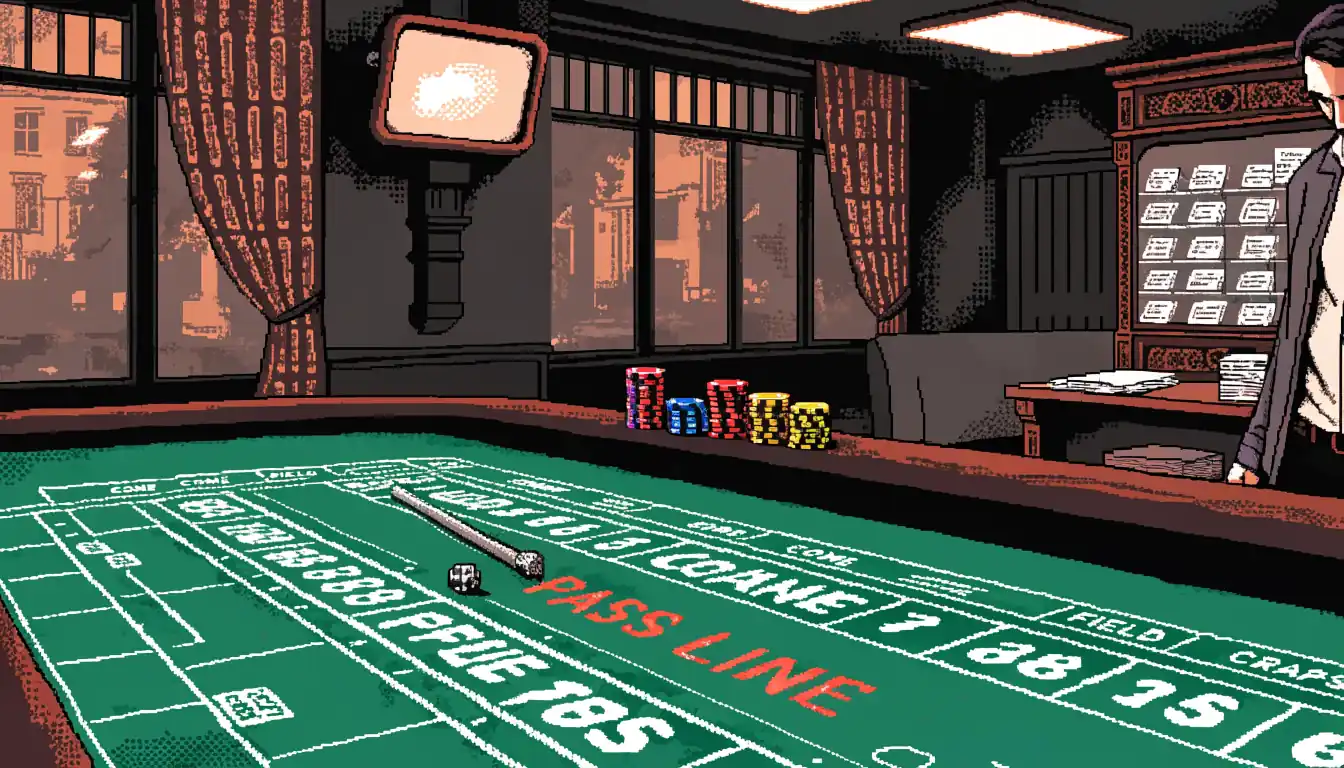
Craps chips and table layout
A digital craps screen should make the relationship between its betting areas and chip controls clear before a stake is committed. The displayed chip value, selected amount and total stake are separate pieces of information; the confirmation screen should reconcile them rather than leave the calculation to guesswork.

A table diagram is useful only when its labels match the controls used to place a bet. If a chip is selected but the interface does not show where it has been placed, or how the displayed stake changes, the layout is not providing enough information for a reliable transaction. The same applies when a game uses coloured chips: colour alone does not establish monetary value. The value shown by the game and the amount confirmed by the casino account are the relevant figures.
For a UK casino, the operator is responsible for deposits, payouts and customer support; a software supplier does not take bets directly from British players. That distinction matters when a game screen and an account statement appear to describe the same stake differently. The operator’s terms govern the account transaction, while the game interface presents the play controls.
Before confirming a wager, the practical check is straightforward: identify the selected chip value, the placement shown on the table and the final stake stated by the interface. If those elements do not agree, the amount is not clear enough to proceed.